.png)
How Blogging Helps Your SEO (And What to Actually Do About It)
Blogging is one of the most practical ways to get found in search and AI answers, but most advice skips why it works. Here's the real mechanism, made simple.

Blogging helps your SEO by giving Google more pages to index and more questions to rank for, keeping your site current, building your internal links and earning the reader's trust. To make it work, write about what your ideal client is searching for, give each post one clear focus, and keep publishing consistently even when results are slow.
If you have been told that blogging is good for SEO but nobody has properly explained why, you are not alone. It is one of those pieces of advice that gets repeated constantly without much behind it.
So let me break it down properly. Not in a way that requires a marketing degree to follow, but in a way that actually helps you understand what is happening when a blog post does its job well. Because once you understand the mechanism, the strategy becomes obvious. (If you are still deciding whether blogging is worth your time at all, start with whether service businesses should still blog. This post is about how it works.)
What Google Is Actually Trying to Do
Before we get into blogging specifically, it helps to understand what Google is trying to achieve. Its job is to match a person's search query with the most useful, relevant, and trustworthy result it can find.
That means Google is constantly evaluating websites and asking: does this site know what it is talking about? Is the content genuinely useful? Is this business a credible source on this topic?
A static website with five pages does not give Google much to work with. A service page, an about page, a contact form, and a couple of testimonials. That is it. There is very little for Google to index, very few questions being answered, and little evidence of what the business actually knows.
A blog changes that. Every post is a new page, a new set of signals, and a new opportunity to show Google exactly what your business knows and who it serves.
The Four Things a Blog Actually Does for Your SEO
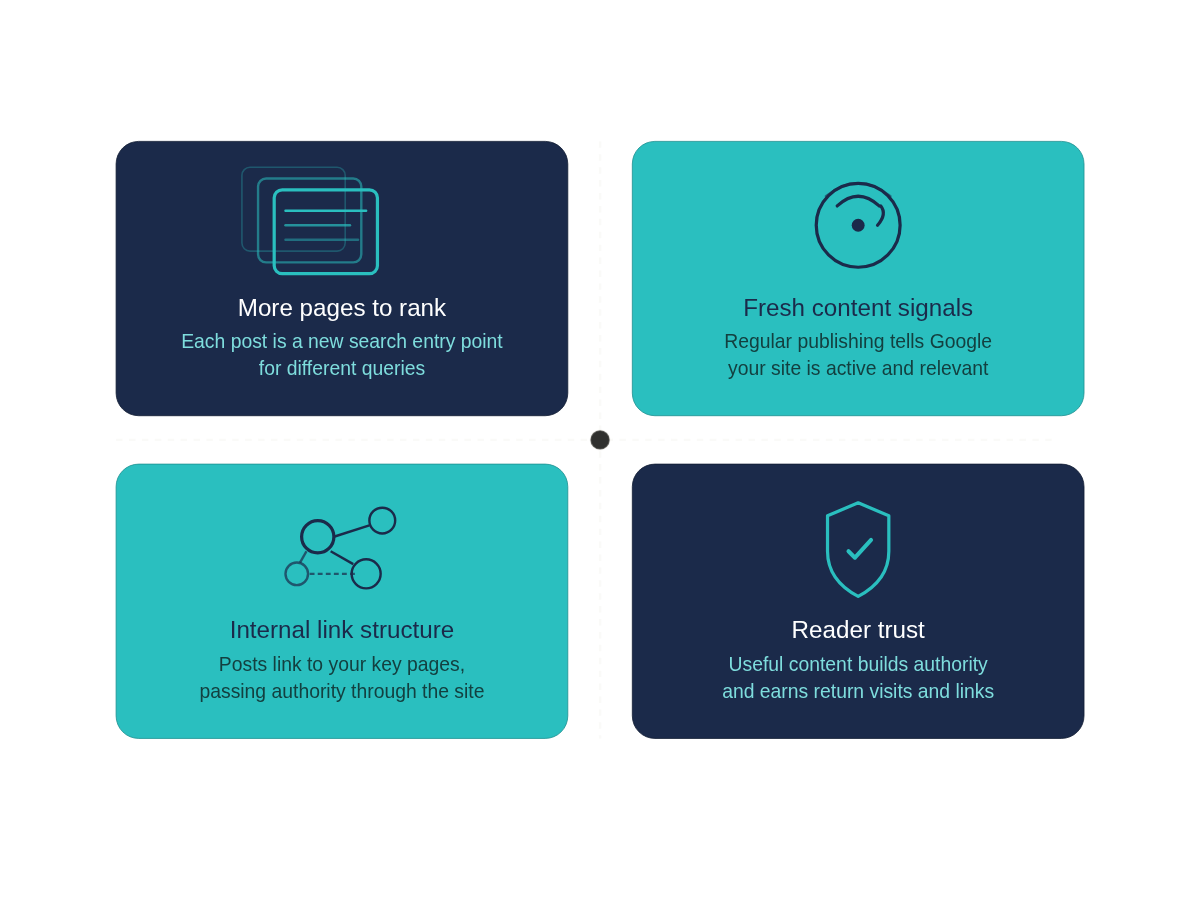
1. It gives you more ground to stand on
Every page on your website can rank for something. A blog dramatically increases the number of pages you have, which means more chances to appear in search results for the specific questions your ideal client is typing into Google.
A financial advisor with five service pages can only rank for five sets of keywords. One with fifty blog posts covering everything from transition-to-retirement questions to what to bring to a first meeting has fifty additional pages working for them at any given time. That compounds quickly.
2. It keeps your site current
Google does not reward a site simply for publishing often, but it does care whether content is current and useful, especially on topics where things change. A website that has not changed in two years looks dormant to visitors, and its information quietly goes stale. A blog gives you a natural, low-friction way to keep adding and updating useful content without rebuilding your entire site every few months.
Frequency matters less than consistency. One well-written post per fortnight, published reliably, builds far more than a flurry of ten posts followed by six months of silence.
3. It builds your internal link structure
Internal links are the connections between pages on your own site. They help Google understand how your content is organised, and they spread authority from high-performing pages to newer ones.
A blog gives you a natural opportunity to do this well. A post answering a common client question can link to the service page that solves it. A post about a client result can link to your case studies. Done consistently, this creates a web of relevance that reinforces your authority in your specific area.
4. It earns the trust of the person reading it
This last one is not usually listed under technical SEO, but it matters just as much. When someone finds your blog through a search, reads something genuinely useful, and thinks 'this person really knows what they are talking about', that is the moment the relationship starts.
They might not book immediately. But they will remember you. They might come back. They might share the post. And when they are ready to invest in the kind of work you do, you are already the person they trust.
Wondering whether your website is ready for the traffic a blog brings?
A brand & web audit shows you what is getting in the way of enquiries, in order of what to fix first.
Not sure what your website is actually costing you?
Four Questions. Two minutes
How to Blog in a Way That Actually Moves the Needle
Understanding why blogging helps is one thing. Knowing how to do it without it becoming a time drain is another. Here is what matters most.
Start with what your ideal client is searching for
The most effective blog topics are not the ones you find most interesting. They are the ones your ideal client is actively typing into Google.
A useful starting point: write down every question a new client has ever asked you before they booked. What did they want to know? What were they worried about? What did they not understand about the process?
Those are your blog topics. Each one is a search query waiting to happen, and a chance to be the person who answers it well.
Give each post one clear focus
One post, one main question. That is the structure that works. Then group related posts around the handful of big topics your business is known for, and link them to each other and to the matching service page. That cluster shows Google, and AI tools, that you cover the subject properly, not just one keyword.
When a post tries to cover too much, it ends up ranking for nothing because Google cannot determine what it is primarily about. A tightly focused post on a specific question will consistently outperform a broad overview that touches on ten things at once.
Once you have your focus keyword, use it in the post title, the first paragraph, at least one subheading, and naturally throughout the body. Do not force it. If a sentence sounds awkward with the keyword in it, rewrite the sentence.
Write like a person, not a content machine
Google has got very good at identifying thin, generic, AI-flavoured content. And more importantly, so have readers.
What still works, and what will keep working, is content that reflects real experience and a clear point of view. If you have an opinion on something, say it. If you learned something the hard way, share it. If there is a common mistake you see constantly in your industry, write about it.
Your voice is not a liability in SEO content. It is an asset. It is what makes your post worth reading rather than skipping.
Write so answer engines can use it
Search has changed. Google now shows AI Overviews at the top of many results, and more people ask tools like ChatGPT and Perplexity for recommendations. These tools lean on pages that answer a question clearly and directly. So put a plain two or three sentence answer near the top of each post, use headings that match how people actually phrase their questions, and back it up with real experience. I go deeper on this in what AEO is and why it matters and how to show up in AI search results.
Keep going when results are slow
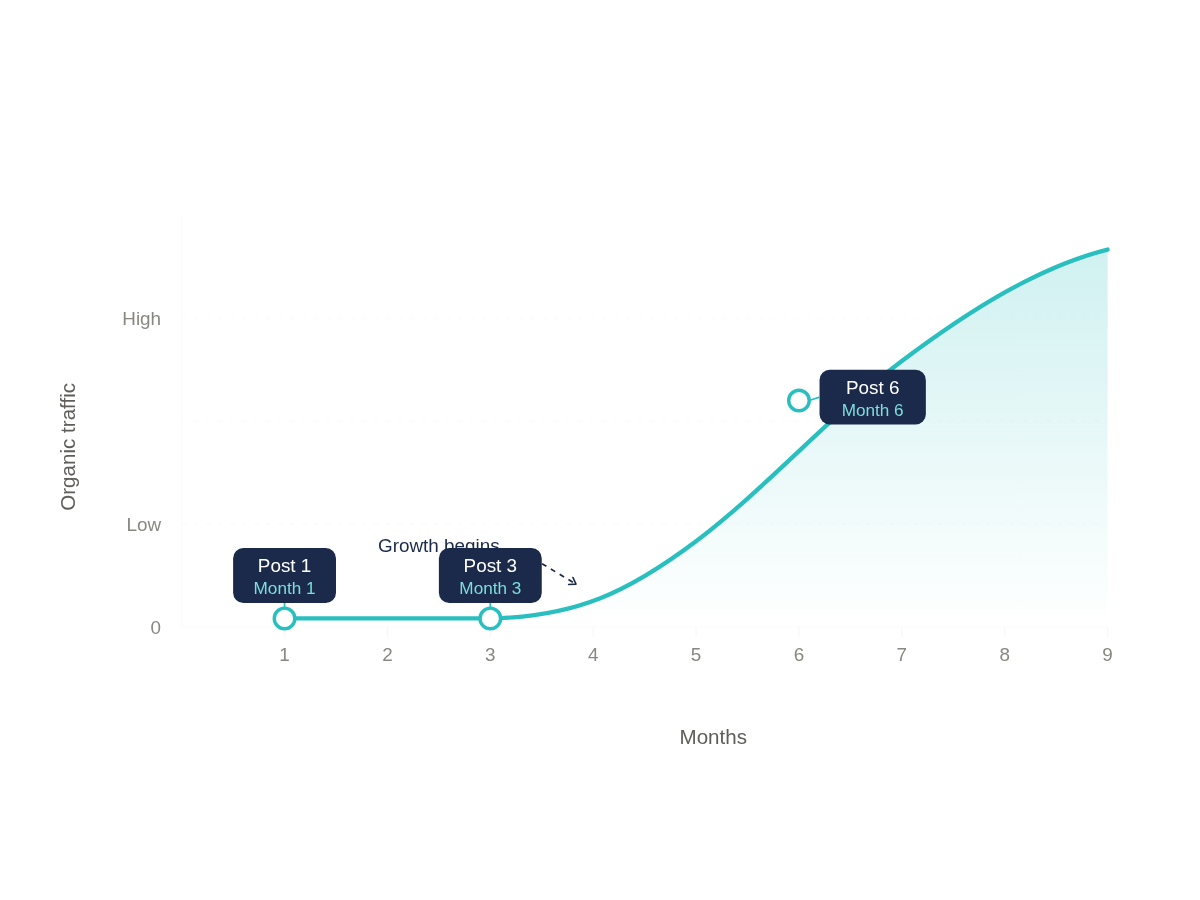
SEO is not instant. A new blog post might take three to six months to build meaningful traction in search results. That is not a sign that it is not working. It is just how the timeline works.
The businesses that see the strongest long-term returns from blogging are the ones that treat it as a slow-build asset rather than a quick-win tactic. The results compound. A post that ranks well in twelve months will keep earning traffic without any additional effort.
How Does Blogging Help SEO?
Blogging helps SEO by giving Google more pages to index, more keywords to rank for, and more evidence that your site knows its subject. Each post is a new opportunity to show up in search results, answer a question your ideal client is already asking, and build the kind of trust that converts a visitor into a lead.
One Thing That Trips Most People Up
The biggest mistake service businesses make with blogging is writing content that is either too broad to rank for anything specific, or too sales-focused to be useful to anyone.
A post called 'Why You Need a Website' is too generic. A post called 'Five Signs It Is Time to Redesign Your Service Business Website' is specific, useful, and speaks directly to the moment a potential client is already in.
The more precisely you write for a particular person at a particular moment in their thinking, the better your SEO will perform. And the more likely that reader is to become a client.
How does blogging help SEO for a service business?
Blogging helps SEO by giving Google more pages to index, more questions to rank for and more evidence that your site knows its subject. Each post is a new chance to show up for a question your ideal client is already asking. It also builds your internal links and earns the trust of the person reading, which is what turns a visitor into a lead.
How often should I publish blog posts for SEO?
Consistency matters more than frequency. One well-written post per fortnight, published reliably, builds far more than a flurry of ten posts followed by six months of silence. Pick a rhythm you can actually keep up, focus each post on one clear question your ideal client is asking, and keep going even when results feel slow to arrive.
How long does it take for a blog post to rank on Google?
A new blog post can take three to six months to build meaningful traction in search results. That is not a sign it is failing, it is simply how the timeline works. Blogging is a slow-build asset rather than a quick win, and a post that ranks well in twelve months can keep earning traffic without any additional effort from you.