.png)
When Your Website No Longer Matches How Good You've Become
When your website no longer matches how good you've become, enquiries stall and pricing gets questioned. Here is how to tell, and what to fix first.

You've outgrown your website when the symptoms show up in sales: you keep explaining things the site should say, good prospects take too long to commit, and the work you win isn't the work you want. Small updates rarely close that gap, so start with the argument your website needs to make, then the design.
There's a particular kind of hesitation that shows up when someone asks for your website. A half second of calculation before you send the link, and a small internal note that you really should get around to sorting that out.
It's not that the site is broken. It works. It looks fine. It's just that it was built for a version of your business that no longer exists, and you know it every time you send it to someone whose opinion matters.
That gap between what you're capable of now and what your website says about you is not a cosmetic issue. It shows up in your pricing conversations, in the calibre of enquiry you attract, and in how long it takes a good prospect to decide you're worth a call. This post is about how to tell how wide that gap has become, why it opens up in the first place, and what to fix before you spend money on anything.
Your business levels up in steps, your brand doesn't move at all
A service business improves constantly and almost invisibly. You take on harder work. You get faster at the thing that used to take you three attempts. You start turning down projects you would have accepted two years ago. You develop opinions about how the work should be done and you stop apologising for them.
None of that updates your website. Your site was set at a fixed point, usually at the moment you had the least money, the least clarity and the most urgency. It captured what you were then and it has been quietly repeating that ever since, to every single person who visits.
So the gap doesn't open suddenly. It widens by a small amount every time you get better, and nobody sends you an alert. You notice it eventually, usually through embarrassment rather than analysis.
The symptoms show up in sales before they show up in design

Most people spot the problem visually, which is the least reliable signal. A site can look dated and still convert well. A site can look current and still undersell you badly. The more useful signals come from your sales conversations.
You find yourself explaining things your website should have said
If the first twenty minutes of every discovery call is spent establishing the level you operate at, your website isn't doing that job. You have become the compensating mechanism for a site that undersells you, which works, but only for the people who make it to a call in the first place.
Good prospects take too long to commit
Hesitation in a qualified prospect is usually a confidence problem, not a price problem. They want what you do. They aren't yet sure you're the calibre of operator they think you might be, because the evidence they were given didn't support it.
The work you win no longer looks like the work you want
If your enquiries have stayed roughly the same while your capability has climbed, your site is still recruiting for the old business. It's advertising a level you've left behind, and people are responding to the ad accurately.
Why small updates usually don't close the gap
The natural response to an outgrown site is to patch it. New photos, refreshed copy on the homepage, a tidier services page. Sometimes that's genuinely enough. Often it isn't, and it's worth knowing why before you spend the weekend on it.
An outgrown website is rarely a surface problem. The structure itself was designed around the questions your earlier clients asked. The order of the pages, the depth of detail, the amount of proof, the way the offer is framed. All of it was built for a buyer with different concerns and a smaller budget. Repainting the rooms doesn't change the floor plan.
The test is whether the site's underlying argument still holds. If the case it makes for you is basically right and just told poorly, new copy and images will fix it. If the case it makes is for a different business than the one you now run, you're editing the wrong document. There's a fuller breakdown of where that line sits in brand refresh vs rebrand.
Not sure which side of that line you're on? A brand & web audit is a recorded walkthrough of your site that tells you whether this is a copy problem, a structure problem or a positioning problem, and in what order to deal with it.
Not sure what your website is actually costing you?
Four Questions. Two minutes
How do you know when you've outgrown your website?
You've outgrown your website when the case it makes for you is weaker than the case you'd make in person. The practical test is whether you hesitate before sending the link, whether calls start by establishing credibility your site should have established, and whether enquiries have stopped matching the level of work you now do.
Start with the argument, not the design
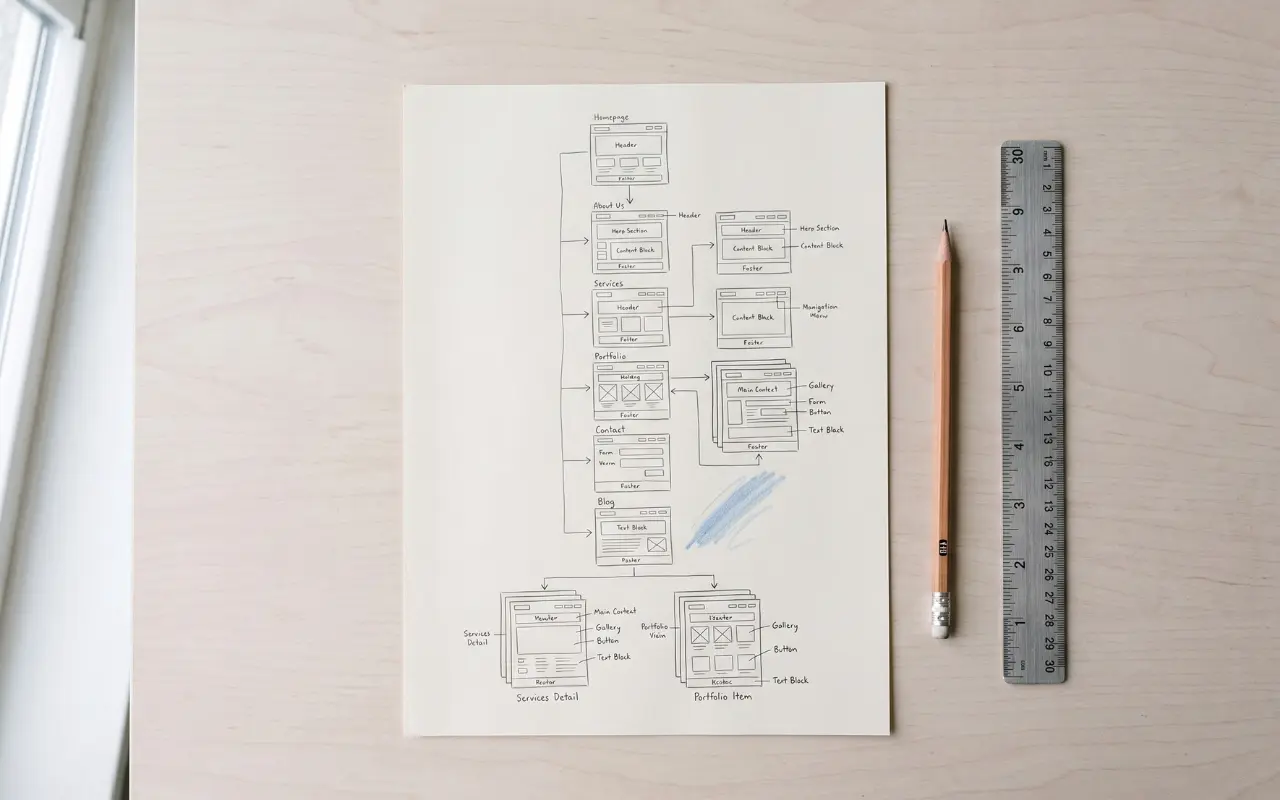
The instinct when a site feels wrong is to go straight to how it looks. That's the most visible layer and the most satisfying to change, which is exactly why it's the wrong place to begin.
The first thing to settle is what the site is actually arguing. Who is it for now, specifically. What situation are they in when they land on it. What do they need to believe before they'll take you seriously at your current rate. What proof supports that belief. What's the one action worth asking for.
Once those are settled, the structural decisions make themselves. You know which pages you need and what order they go in. You know how much proof to show and which client stories earn a place. You know what the homepage has to establish in the first screen. Design then becomes a matter of expressing a decision that's already been made, rather than a way of avoiding making it.
This is also why sites get rebuilt twice in three years. The first rebuild changed the appearance and left the argument untouched, so the site looked better and performed the same. The approach in how to rebrand your service business without starting over covers how to sequence this without throwing away what still works.
What you're actually buying back
The practical outcome of closing this gap is that your website starts doing work you were previously doing yourself, in person, one prospect at a time.
Credibility gets established before the call instead of during it. People arrive already understanding the level you work at, so the conversation begins at approach and fit rather than at justification. The enquiries that were never a match stop arriving, because the site now describes a business they can tell isn't for them. And you stop hesitating before you send the link, which sounds like a small thing and turns out not to be.
The difference between a business that's known for its work and a business that's paid properly for it is rarely the work. It's whether the evidence is visible to someone who hasn't met you yet.
Do I need a full rebuild or can I update what I have?
It depends on whether the structure still fits. If the pages and their order still match how your buyer decides, new copy and images will do the job. If the site is organised around an offer, audience or price point you've moved past, updating the surface will not fix it and you're better off rebuilding the structure.
How often should a service business update its website?
There's no fixed interval worth following. A better trigger is change in the business. If your pricing, ideal client or core offer has shifted meaningfully since the site was built, it's out of date regardless of how recently it launched. Most established service businesses hit that point every two to three years.
Will changing my website confuse existing clients?
Rarely, because existing clients relate to you rather than to your website. They've already bought and their experience of you is direct. The risk sits with referrals, who arrive with a description from someone else, so it's worth giving your regular referrers updated language for what you do at the same time.