
Why Your Referrals Aren't Converting (And How to Fix It)
Referrals not converting? Usually your clients can't describe you clearly and your website doesn't back them up. Here's how to fix both and book more.

Referrals usually stop converting for two reasons. The person referring you can't explain what you do in one clear sentence, and when the prospect checks your website, it doesn't back up what they were told. Fix the sentence, make your site match your reputation, and reply within 24 hours.
A past client raves about you to a friend. The friend says, "Oh, send me their details." You get excited. Then nothing. No call, no email, no booking.
Or they do book, and ten minutes into the call you realise they wanted something you don't even offer.
This is one of the most confusing problems in a service business. Referrals should be the easiest sale you'll ever make. Someone already trusts you enough to vouch for you. So why do so many go cold before they reach your calendar?
Your work is fine. The trouble sits in the quiet stretch between the introduction and the conversation, where you aren't in the room. Here's what goes wrong there, and how to fix it.
What Happens Between the Referral and the Booked Call?
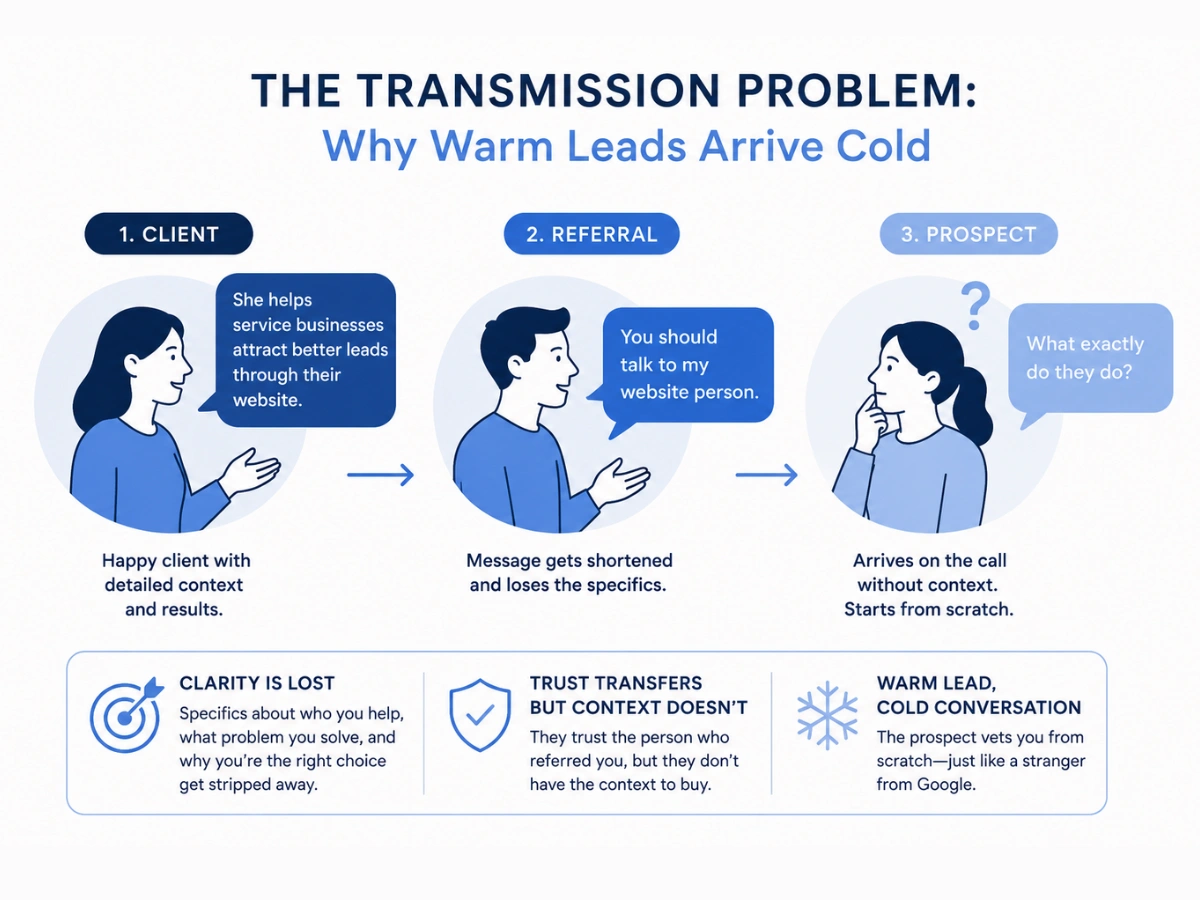
Two things happen, and you rarely see either of them.
First, your client passes you on. A referral transfers trust, but it also has to carry information: who you help, what problem you solve, and why you're the right choice over anyone else. Most clients can't do that part well. They know you did great work for them. They don't have the words to describe it. So the message that reaches their friend is something like "you should talk to my web person, they're really good." That's warm. It's also almost useless.
Second, the friend looks you up. Almost nobody calls straight away. They Google your name to check you're legit and to see whether you look like the person their friend described. That visit is a test. Your website either confirms what they heard or makes them second-guess it.
The ones who second-guess never tell you. They quietly move on, and you assume they got busy.
Why Can't My Clients Explain What I Do?
Because you haven't given them a sentence worth repeating.
Referrals convert in direct proportion to how easy you are to describe. If your positioning is broad, something like "we help businesses grow," your happiest client still can't pass that on in a way that means anything to their friend. A vague description produces a vague referral, and a vague referral produces a cold, unqualified call.
Clear positioning fixes this at the source. If your client can say "they sort out the brand and website for clinics that are great at the work but hard to find online," that sentence does the qualifying for you. The right people lean in. The wrong people rule themselves out before they ever pick up the phone.
It's why two businesses with equally happy clients can get very different results from referrals. How happy the client was matters less than whether they had the right words to pass on.
Does My Website Decide Whether a Referral Books?
Very often, yes. A referred visitor arrives with high expectations, so your site has to meet them. These are the signs it's letting referrals down:
- It looks rushed, dated or like a template, so it doesn't match the brilliant, organised person they were told about.
- The thing they were referred for is buried, or missing from a list of twelve services.
- There's no proof beyond the person who referred them: no testimonials, case studies or results from clients like them.
- Booking is hard work, with no clear button, a form that disappears into the void, or only a phone number.
- The headline says "Welcome to our website" instead of who you help and what you help them with.
None of these mean your work is poor. They mean your reputation is running ahead of your website. In person you're excellent, and clients feel it. Online, the business is still presented at the level it was when you first set it up. Referrals are where you feel that most, which is also why referrals stop scaling once a business grows.
Not sure what your website is actually costing you?
Four Questions. Two minutes
How Do I Make My Website Back Up the Referral?

Look at your site the way a referred stranger would, then work through these in order:
- Say who you help in your headline. A referred visitor should know within seconds they're in the right place.
- Give your two or three main services a clear home each, using the same words your clients use when they recommend you.
- Show proof that matches the referral. If you work with clinics, show a clinic's result.
- Give them one clear way to book, the same on every page, and tell them what happens after they click.
- Ask a past client to describe what you do, then check your homepage says the same thing.
When this lines up, referrals stop being a gamble. Beneath the Palms Midwifery already had a website, but it had no strategy behind it. After a brand strategy and website rebuild, the practice was booked out for the year within three months and added two new services. The referrals didn't suddenly get better. The website finally backed them up.
It works for professional referrers too. A GP who refers a patient wants to feel safe doing it again, and this Cairns EMDR therapist's story shows what happens when the website earns that trust.
What Should I Do in the First 24 Hours After a Referral?
Move quickly while the introduction is still warm. A referred prospect stays warm for a short window, and a slow, generic reply lets it cool.
Reply within a day. Name the person who referred them, so the trust carries across. Then ask one or two questions that confirm fit before the call, so you aren't working it out live on the phone. That keeps the momentum and filters out mismatched leads before they take an hour of your week.
If you want this to happen every time instead of when you remember, here's how to build a referral system that doesn't rely on luck.
Why Aren't My Referrals Converting?
Most referrals stop converting because the referrer can't describe you clearly and your website doesn't confirm what they said. The prospect arrives without context, checks your site, finds a mismatch or no easy next step, and quietly moves on. Sharpen your one-sentence description, make your website match your reputation and reply within 24 hours.
Referrals Prove Your Work Is Good, So Give Them Somewhere to Land
Referrals are proof your work is excellent. That part is done. What's usually missing is a clear sentence people can repeat and a website that tells the same story your clients are telling.
Get both right and the same network that's been sending mixed results starts sending the right people, more often. And on the quiet months, you're not stuck waiting, because a site that converts referrals also helps you win clients without relying on referrals.
Do referred clients check your website before they get in touch?
Yes, most of them do. Even with a glowing recommendation, people usually search your name first to confirm you are credible, see your work and get a feel for how you operate. That visit often decides whether a warm referral becomes an enquiry or quietly goes cold, so your website needs to match what they were told.
What should a referred visitor see first on my website?
A clear headline that says who you help and what you help them with, followed quickly by proof from clients like them. Add one obvious way to book and a line about what happens next. That gives a referred visitor enough confidence to reach out without digging around your site.
How quickly should I follow up on a referral?
Within 24 hours. A referred prospect is warm for a short window, and a slow or generic reply lets that cool. Mention the person who referred them by name so the trust carries across, and ask one or two questions that confirm fit before the call. That keeps momentum and filters out mismatched leads.