.png)
How to Attract Premium Clients to Your Service Business
Want to attract premium clients? Learn the positioning, pricing, and website changes that turn your service business into the obvious choice.

You attract premium clients by looking, sounding and operating like you're worth the investment before anyone books a call. Position yourself as a specialist in one problem, price for the value you deliver rather than the hours you work, and make your website prove you can do the job with specific case studies and outcomes.
Every service business owner has had that one client. The one who negotiates every invoice, questions every hour, and disappears the moment a cheaper option turns up. You didn't get into business to work with that client. You got into business to do great work for people who value it.
Premium clients exist in every industry. They pay on time, trust your expertise, and refer you to more people just like them. The problem is they don't find you by accident. They find businesses that already look, sound, and operate like they're worth the investment.
Attracting premium clients isn't about raising your prices and hoping for the best. It comes down to how you position your business, how you price your work, and what your website proves before anyone books a call. Get those right and premium clients start finding you, instead of the other way around.
Here's how to make that shift.
Why Premium Clients Skip the Cheapest Option
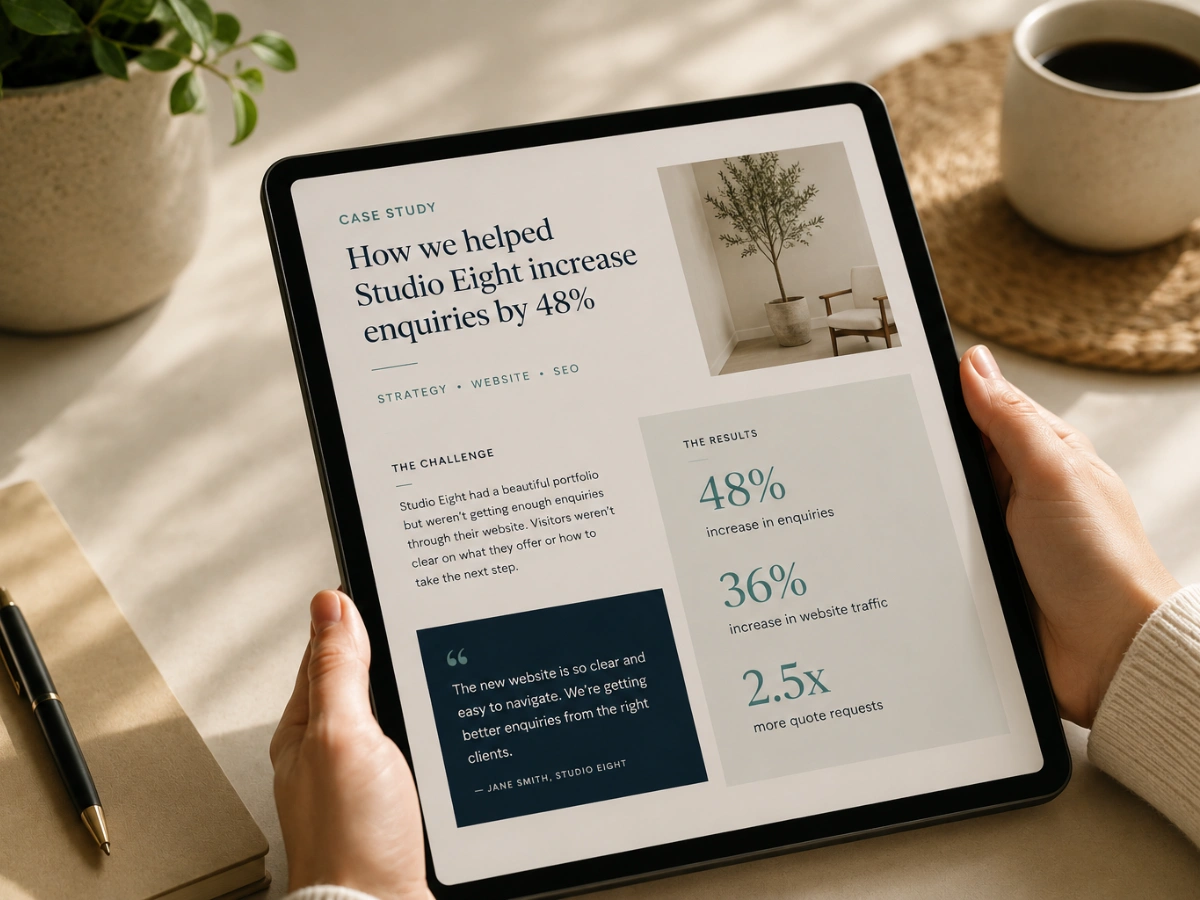
Premium clients aren't shopping on price. They're shopping on risk. When someone is about to hand over a serious budget for a website rebuild, a rebrand, or an ongoing retainer, they're really asking one question: will this go wrong?
Cheap providers carry more perceived risk, not less. A rock-bottom quote signals corners will be cut somewhere, whether that's communication, quality, or timelines. Most premium clients have been burned by a cheap option before. They're not looking to repeat that mistake.
What convinces them instead is evidence. Case studies with real numbers. Testimonials that mention specific outcomes rather than vague praise. A process that sounds considered rather than improvised. None of this needs a bigger budget on your end. It needs clarity about what you show and how you say it.
If your marketing currently competes on price, even quietly, that's the first thing to fix. Premium clients need a reason to believe you're worth more, and that reason has to show up before they ever speak to you.
Position Yourself as a Specialist, Not a Generalist

This is where a lot of excellent businesses quietly lose premium clients. Not because the work is not good enough, but because nothing about how they describe it makes them the obvious choice.
Pick the One Problem You Solve Better Than Anyone
Generalists compete on availability. Specialists compete on outcome. If your website says you help "small businesses grow online," you're competing with every agency and freelancer offering the same vague promise. Premium clients skip straight past copy like that because it tells them nothing about whether you understand their specific problem.
Narrow the story. Instead of "I build websites," try something like "I help established service businesses that win on referrals become the obvious choice online, so the right clients stop comparing them on price." That sentence does more selling than a full page of generic copy, because the right client reads it and thinks: that's exactly what I need.
This doesn't mean turning away other work behind the scenes. It means your public-facing positioning, your homepage, your blog, your social bio, speaks to one clear type of client with one clear problem. Premium clients want a specialist for their exact situation, not a jack of all trades hoping to figure it out.
Not sure what your website is actually costing you?
Four Questions. Two minutes
Price for the Value You Deliver, Not the Hours You Work
Hourly pricing invites comparison. The moment a prospect can measure your rate against someone else's rate, you're in a race to the bottom, and premium clients rarely want to be in that race with you.
Value-based pricing changes the conversation. This is strategic pricing, not guesswork. Instead of quoting a rate per hour, quote a price tied to the outcome: a new site that converts, a brand that lets you raise your own prices, a campaign that fills a calendar for a quarter. When the price is tied to a result, hours stop being the point.
Confidence matters here too. If your proposal hedges, discounts before being asked, or apologises for the number, premium clients notice. They're used to paying for outcomes elsewhere in their business, and they'll pay for outcomes with you, provided your pricing carries the same confidence your work deserves.
Make Your Website Do the Convincing Before the Call
Premium clients rarely enquire first and research later. They do their homework quietly, often after a referral, and your website is where most of that homework happens.
Every Page Should Answer One Question: Can They Do This?
By the time a premium client books a call, they've usually already decided you're capable. Your website did that work before you said a word. If it's cluttered, generic, or unclear about who you help, it undoes everything else you've done right.
Look at your homepage the way a stranger would. Does it give a prospect clarity on who you work with and what result they can expect? Is there proof, real case studies with real numbers, not just a logo wall? Is the path to enquire obvious, or does someone have to hunt for a contact form buried three clicks deep?
If your site currently reads like every other service provider in your industry, that's worth fixing before you invest in more traffic. My $500 brand & web audit gives you a recorded walkthrough of exactly what's holding your site back from attracting the clients you actually want, plus an ordered list of what to fix first.
How Do You Attract Premium Clients?
To attract premium clients, position yourself as a specialist rather than a generalist, price around the value you deliver rather than hours worked, and make sure your website proves your expertise before a prospect ever books a call. Premium clients buy confidence and results, not the cheapest quote in their inbox.
Conclusion
Premium clients aren't hiding. They're out there right now, searching for someone who understands their exact problem and can prove they'll solve it well. The businesses that win them aren't always the most talented, they're the ones whose positioning, pricing, and website all say the same thing: we're worth the investment.
That's the work I do every day in True Bearings: brand strategy and a website for established service businesses that have been winning on referrals, are done competing on price and are ready to be seen as the obvious choice.
What do premium clients look for when choosing a provider?
Premium clients shop on risk, not price. They want evidence that the project won't go wrong, such as case studies with real numbers, testimonials that mention specific outcomes and a process that sounds considered. A rock-bottom quote actually increases perceived risk, because it suggests corners will be cut somewhere along the way.
Should I charge hourly or use value-based pricing?
Value-based pricing usually suits premium clients better. Hourly rates invite comparison and push you into a race to the bottom. Tying your price to an outcome, such as a website that converts or a brand that lets a client raise their own prices, shifts the conversation away from hours and towards results.
Why does being a specialist help attract premium clients?
Generalists compete on availability, while specialists compete on outcome. Premium clients want someone who understands their exact situation. When your homepage, blog and social bio speak to one clear type of client with one clear problem, the right client reads it and recognises that you are exactly what they need.