.png)
What to Invest in First: Branding, Website, or Marketing?
The order you invest in branding, your website and marketing matters. Get the sequence right and each step makes the next one work harder, not cost more.

Invest in branding first, then your website, then marketing. Branding defines what your business is and who it serves, the website gives that brand a home and a clear path to enquire, and marketing sends the right people to something that's ready to convert them. Getting the order wrong usually costs more overall.
What to invest in first is one of the questions I get most often from established service business owners. The work is good, referrals have carried the business this far, and now they are ready to invest in how the business shows up. They just are not sure where to start.
The honest answer is that the order matters more than most people realise. Get it right and each investment strengthens the next. Get it wrong and you end up spending more overall to reach the same place, because you are fixing problems that a better starting point would have avoided.
So here is my direct take on the sequence, why it works that way, and how to know where you are in it right now.
Why the Order Matters
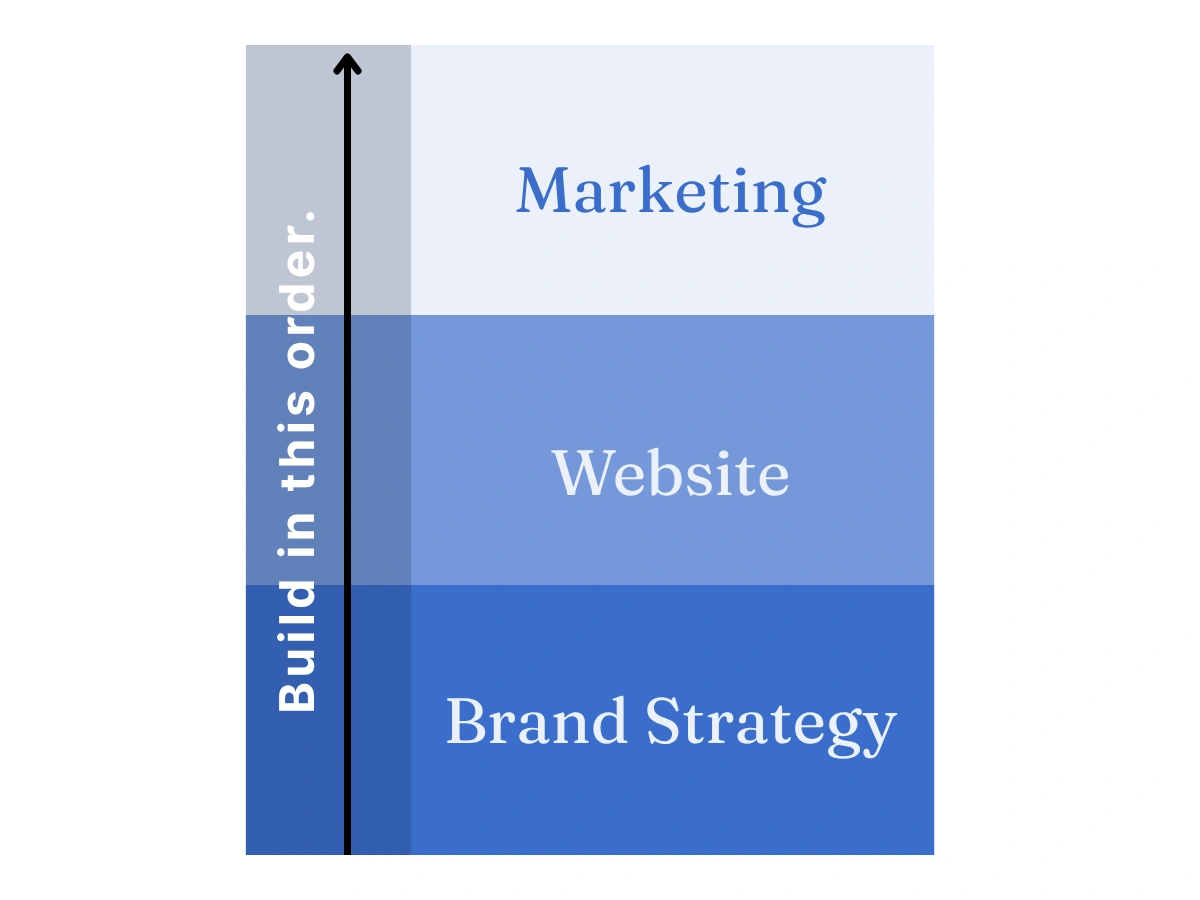
Branding, a website, and marketing are not interchangeable. They are not three separate options for achieving the same outcome. They are three layers of a system, and that system works best when it is built in a specific order.
Branding is the foundation. It establishes what your business is, who it serves, and how it should be perceived. It determines the language your business uses, the visual identity it presents, and the position it occupies in the mind of its ideal client.
The website is the platform the brand lives on. It takes the brand strategy and gives it a home, a structure, and a conversion pathway. A website built without a clear brand strategy is just a template with your services listed on it. It looks like a website but it does not do the work of one.
Marketing is how you send people to the brand and website you have built. It is the engine. But an engine pointed at a weak brand and a non-converting website does not produce growth. It produces traffic and disappointment.
When you build in this order, each layer is ready for the next. When you skip layers or reverse them, you spend the same money but lose the compounding effect that comes from each element supporting the others.
Start With Branding, Even If You Have Been Trading for Years
If your business has grown past the brand it started with, branding is the right place to start. That is true whether you have been trading for three years or fifteen. Not because it is the most exciting investment, but because every other investment will be stronger for having it in place.
Brand strategy answers the questions that every other business decision depends on. Who is your ideal client, specifically? What problem do you solve for them? What makes your approach different from the alternatives? What should someone think, feel, and do when they encounter your business for the first time?
These are not marketing questions. They are strategic ones. And the answers shape everything downstream, from the words on your website to the way you describe your services to the kind of clients you attract and the prices you can hold.
What brand work looks like in an established business
For a business that has been running a while, brand work is rarely about starting from nothing. You already have clients who rave about you, a way of working that gets results, and a reputation inside your network. The job is to get that out of your head and out of your referrals, and turn it into something clear and written down: who you are for, what you do for them, and why you are the better choice.
Once that is clear, the visual side has something to express and the website brief almost writes itself. Skip it, and you end up with a nice new look sitting on top of the same fuzzy message.
Not sure whether your brand foundation is solid enough to build on?
Book a 30-minute call with me. It is not a pitch. I will help you see where the gaps are and what needs to happen first.
Invest in the Website Once You Know What It Needs to Say
The most common website mistake I see is building the site before the brand strategy is clear. The brief goes to the designer or developer, the design work begins, and halfway through someone realises that the copy does not reflect the positioning, or the services are not described in a way that speaks to the right client, or the whole thing needs to be restructured because the ideal client has been redefined.
None of that is the designer's fault. It is a sequencing problem. The website cannot do its job until the brand strategy has defined what that job is.
Once the brand foundation is in place, the website brief becomes dramatically clearer. You know who you are writing to, what they need to understand, what action you want them to take, and what proof will build the confidence to take it. The design work flows from that clarity rather than being assembled around it.
What a website needs before marketing points people at it
Before you invest in driving traffic to your website, it needs to be able to convert that traffic. That means a homepage that clearly communicates who you serve and how in the first few seconds. It means a services section that describes outcomes rather than just deliverables. It means proof, visible and specific, close to the moments in the user journey where doubt tends to arise. And it means a clear, singular call to action that gives a ready visitor somewhere obvious to go.
A website that lacks any of those things will underperform regardless of how much traffic arrives. Marketing spend sent to a website that is not ready to convert is one of the most common ways service businesses waste their budget, and it is entirely avoidable if the sequencing is right.
Not sure what your website is actually costing you?
Four Questions. Two minutes
Marketing Is the Accelerator, Not the Starting Point
Once your brand is clear and your website is converting, marketing is where additional investment produces strong returns. You are no longer sending people to something that is not ready for them. You are amplifying a system that is already working.
At this stage, the specific marketing channel matters less than most business owners think. Content marketing, social media, email, SEO, paid advertising: all of these can work well when the brand and website behind them are solid. The choice of channel should be driven by where your ideal clients actually spend their time and attention, not by what seems most popular or what another business in your space is doing.
When marketing can come first
If you are adding a new service or heading into a new market, you do not need to rebuild everything before you find out whether anyone wants it. Talk to a handful of past clients, put up a simple page, run a small test. Real enquiries (or the lack of them) will tell you more than any amount of planning.
Once the new offer has proven itself, bring it into the brand and website properly. Tests are meant to end. The ones that hang around for years become the patchwork that makes a good business look disorganised.
Should I Invest in Branding, a Website, or Marketing First?
The order that consistently produces the best results is branding first, then website, then marketing. Branding establishes what your business is and who it serves. The website gives that brand somewhere to live and work. Marketing then sends the right people to a brand and website that are ready to convert them. Reversing this order is one of the most common and expensive mistakes a growing service business can make.
How to Know Where You Are in the Sequence
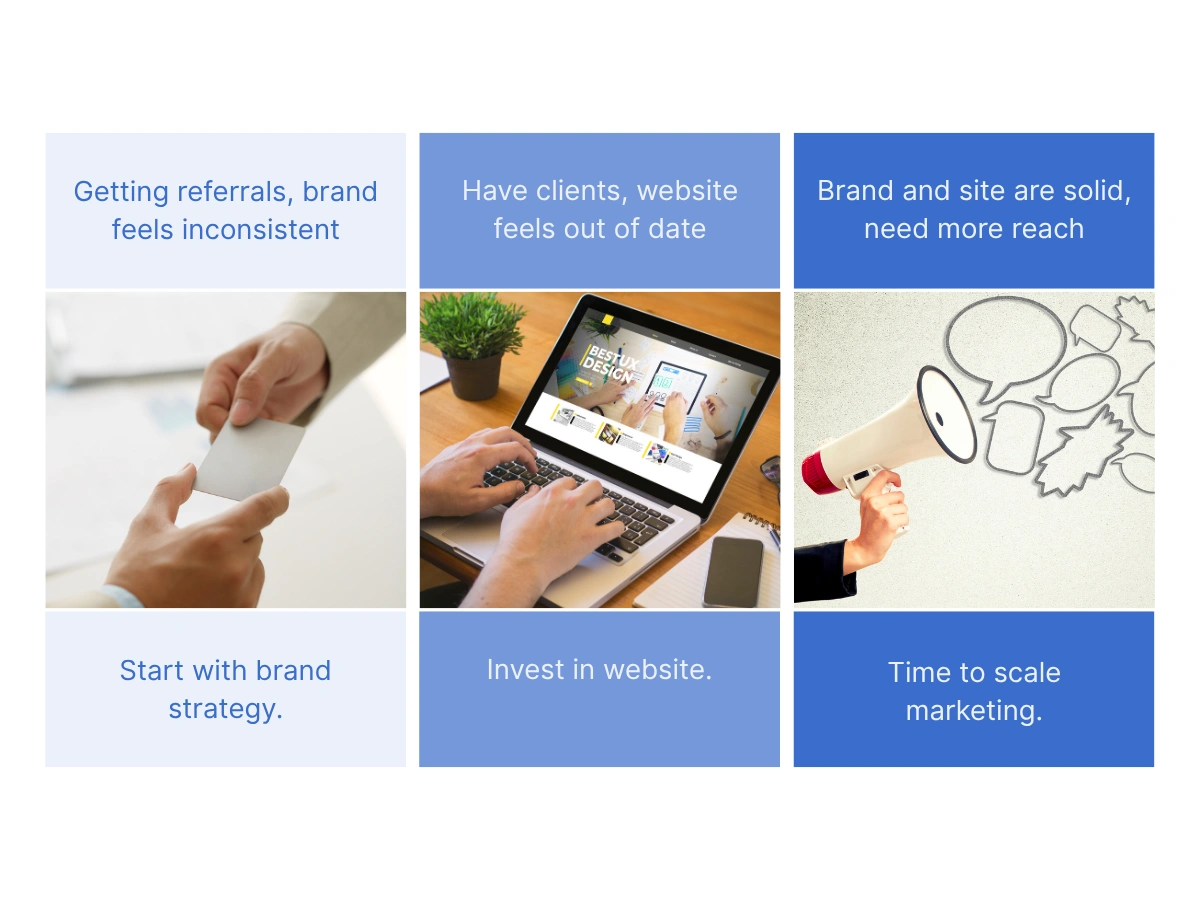
The question worth sitting with is not 'what should I invest in next' but 'what is actually blocking growth right now.'
If your business is getting traction through referrals but nothing about your brand feels intentional or consistent, brand strategy is the gap. You have proven the offer works. Now you need to build the foundation that lets it scale.
If you have a brand and some clients but your website is a template you built two years ago that you quietly apologise for when you send someone the link, the website is the gap. The brand foundation is there. The platform it should live on is not doing its job. A brand & web audit will show you exactly what to fix first.
If your brand is clear, your website is converting, and the main constraint is that not enough of the right people are finding you, marketing is the gap. The system is ready. Now you accelerate it.
Most service businesses I work with are somewhere in the first or second scenario. They have something that works but they have not invested in the foundation that would let it work properly at scale. The brand strategy is unclear or unfinished. The website was built in a hurry or at an earlier stage and has not caught up with where the business is now.
The fix is almost never complicated. It is usually a matter of going back to the layer that was skipped and building it properly, so everything that sits on top of it can do its job. When both the brand and the website need work, it makes sense to do them together. That is what True Bearings is: four weeks, brand strategy first, then the website built on top of it, so the two never drift apart.
Should I invest in branding, a website or marketing first?
The order that consistently works best is branding first, then your website, then marketing. Branding defines what your business is and who it serves. The website gives that brand a home and a conversion pathway. Marketing then sends the right people to a brand and website that are ready to convert them. Reversing the order usually costs more overall.
Why should I sort out my brand before building a website?
Because the website cannot do its job until the brand strategy has defined what that job is. Building the site first often means realising halfway through that the copy does not reflect your positioning or speak to the right client. With the brand foundation in place, the website brief becomes much clearer and the design flows from that clarity.
How do I know which area my business needs to focus on next?
Ask what is actually blocking growth right now. If referrals are working but nothing about your brand feels intentional, brand strategy is the gap. If your brand is sound but your website is an outdated template, the website is the gap. If both are working and not enough of the right people are finding you, it is time for marketing.