.png)
What the True Bearings Method Is, and Why It Takes Four Weeks
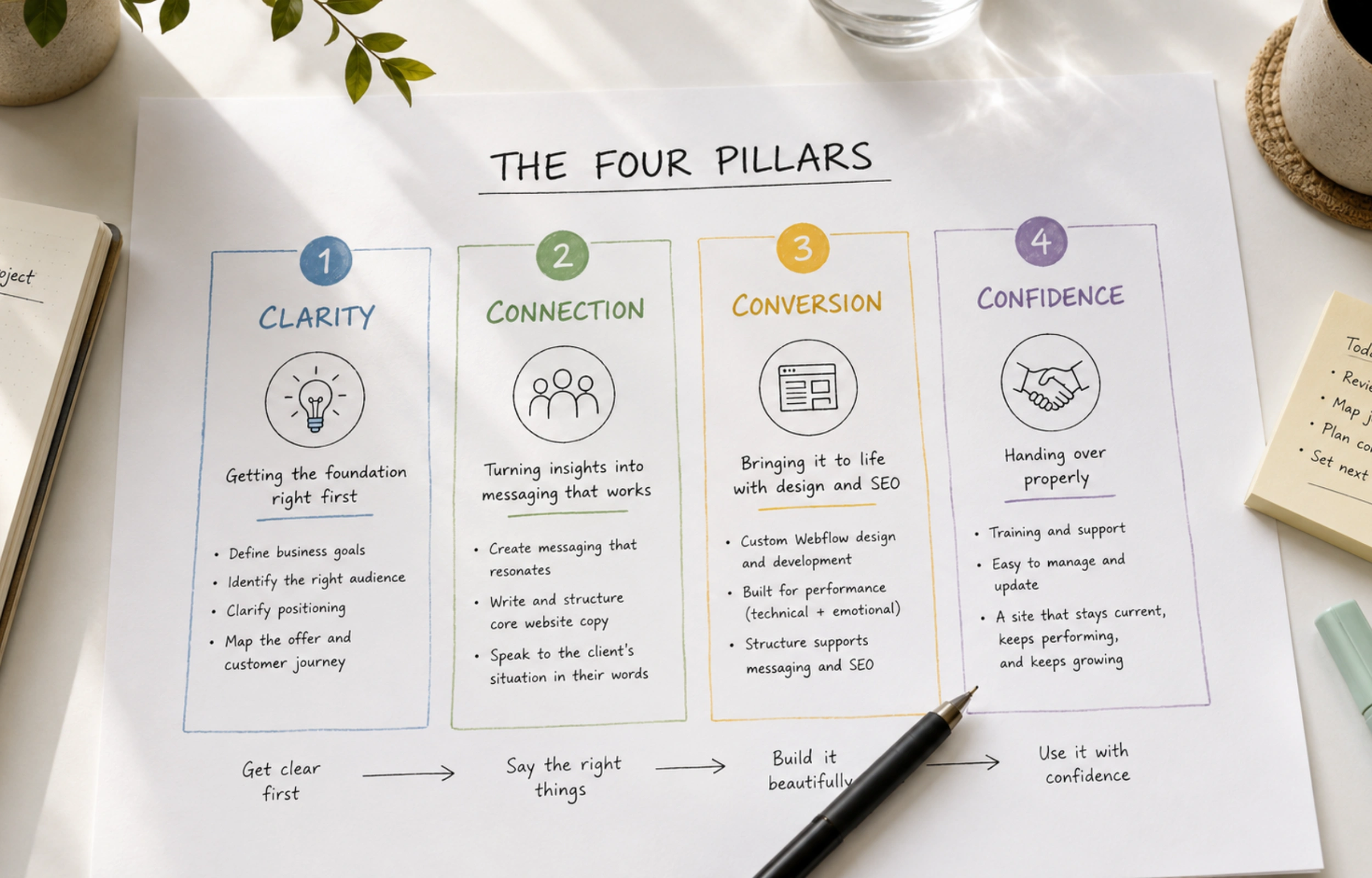
True Bearings is how I take a service business from hard to explain to the obvious choice in four weeks: strategy first, then copy, design and search.
Most of the businesses I work with aren't struggling. The work is good. Referrals come in. Clients come back. And growth still has a ceiling on it, because the trust lives with the founder and the website hasn't explained the business to anyone who hasn't met you yet.
True Bearings is how I fix that. This post explains what it is, how the four weeks run, and why it's built in the order it is.
What True Bearings is
True Bearings is my strategy and website project. Four weeks, done for you. Strategy, copy, design and a website built to convert, in that order.
Your part is small on purpose. One deep dive with me, then a handful of approvals: the direction, one round of feedback on the copy and one on the design. One deep dive. A handful of approvals. We take care of the rest.
You don't need your messaging sorted or your pages mapped before you come to us. Working that out is what you're paying for.
Who it's for
Established service businesses where the work is already proven. Usually the founder is the reason people choose, and either the first hire is coming or the team already exists and clients still ask for you by name.
It isn't for you if you're after the cheapest option, or a guarantee that a website on its own will bring in clients. Nobody can honestly give you that.
Why it's built this way
I started in a sign shop. Signwriting apprentice, then graphic designer, then project manager, then marketing. Then nearly seven years running Meta and Google ads for a university.
That ads job taught me the thing this whole method sits on. You can be very good at getting the right people to a website, and it changes nothing if the website isn't ready for them. I spent years on the traffic half of the problem and watched the other half undo it.
When I was made redundant in 2024 and went full time on this business, that lesson became the process. Clarity before design. Conversion before traffic. Direction before build. Twenty-one websites later, it's still the order.
The four steps
01. Get clear
Before anyone writes a word or opens a design file, we decide what the business needs to be known for. Who you need to be the obvious choice for. What problem you own. What makes you different in a way a stranger can check for themselves, which rules out "we care" and "quality service".
If you have a team, or you're about to, we also work out why someone can feel confident with any of them and not only with you. That's usually the missing piece, and it's the one that lets a business grow past its founder.
Copy and design can only deliver a decision that's already been made. Skip this step and you get a good looking website that says roughly what your competitors say. If you want the longer version of why, I've written about what brand strategy actually is.
02. Get conversion-ready
The direction becomes the message, the structure and the site. We write every word for the person you're trying to reach, then map the pages around how someone actually decides: what they need to understand, what they need to trust, and what makes them ready to get in touch.
Every section has to move that decision forward. A beautiful site that says nothing is the expensive version of doing nothing. More on that in website copy that converts.
03. Get found
Search and AI foundations go into the structure, the content and the technical setup from the start, not bolted on after launch. That covers Google and the answer engines people now ask instead. If that's new to you, here's what answer engine optimisation is.
It's the third step on purpose. Sending more people to a site that isn't ready is how marketing budgets disappear. And I won't promise you rankings. Search visibility builds over time, and anyone guaranteeing it is guessing.
04. Know how to grow
Most website projects end at launch, which is the moment you finally have something to learn from. So we set up tracking you can actually read, and you get a Growth Roadmap: what to focus on next, in order.
Then handover and training, 30 days of post-launch support, and a checkpoint at ninety days where we look at what's happening together.
Not sure what your website is actually costing you?
Four Questions. Two minutes
Why four weeks, and not faster
Four weeks is quick for a strategy and website project. It works because the big decisions get made in week one, with you, and then they stay made. My team builds from a direction you've already approved, so nobody is designing while guessing.
Four weeks does rely on feedback and approvals coming back within the agreed timeframes. That's most of what your part is, and it's the part that keeps the project moving.
It isn't faster because the thinking doesn't compress. Production is cheap. Direction isn't.
Can't AI just do this now?
AI can build a website, and it will probably look fine. What it can't do is decide what your business should be known for, because it only knows what you tell it. If the message you have now isn't landing, AI gives you a faster, more polished version of the same problem.
The decisions are the work. The website is what happens after them.
You can stop after the first phase
At the end of the first phase you see the strategy and the site structure before anything gets built. If you don't believe in the direction, you stop there and keep the strategic work you've paid for. If you approve it, we move into copy, design and build.
I'd rather you leave with a strategy you trust than a website you don't.
What it looks like when it works
Beneath the Palms Midwifery in Cairns is now booked out for the rest of the year, and has added two new services. Caitlin's words: "It's amazing. I get so many enquiries but having to say no is really hard. Not a bad problem to have."
Unfurl EMDR, also in Cairns, was getting around two website enquiries a week and roughly one GP referral a week within two months of launch.
Both started with the strategy, not the design. You can see more of the work in the portfolio.
Who leads it, and what it costs
I personally lead the strategy on every True Bearings project. The deep dive, the positioning and the decisions the site gets built on don't get handed to anyone. That's why we only take on three new projects a month. My team, the "& Co", builds it from there.
It's quoted rather than fixed, because no two projects are the same. You can pay in full or across four milestone payments.
If the full project isn't the right size for you yet, there's a smaller way in. A paid brand & web audit is $500, and it's credited toward the project if you go ahead within sixty days.
Why it's called True Bearings
Third Raven comes from the Norse sailor Hrafna-Flóki, whose third raven gave him his direction to land. The "& Co" is the crew. My maiden name is Rutter, and a rutter was a sailor's book of bearings. So a method about setting the right direction before anything gets built was always going to end up with a name like this one.
What is the True Bearings Method?
True Bearings is Third Raven & Co's four-week, done-for-you strategy and website project for service businesses. It runs in four steps: get clear on what the business should be known for, turn that into copy and a site built around how people decide, build in search and AI foundations, then leave with tracking, a Growth Roadmap and a ninety day checkpoint. Your part is one deep dive and a handful of approvals.
Can't I just use AI to build my website?
You can, and it will probably look fine. What AI can't do is decide what your business should be known for, because it only knows what you tell it. If your current message isn't landing, AI gives you a faster, more polished version of the same problem. The decisions are the work. The website is what happens after them.
How much of my time does True Bearings take?
Very little. One deep dive with Hayley, approval of the direction, one round of feedback on the copy and one on the design, then a handover call and a ninety day checkpoint. You don't need your messaging sorted or anything written before you start. Working that out is part of the project.


.jpeg)