.png)
What to Say When a Client Tells You You're Too Expensive
When a client says you're too expensive, it is rarely about price. Here is exactly what to say, and what to fix so you stop hearing it often.

When a client says you're too expensive, don't apologise and don't discount. Get curious about what's behind it, reconnect your price to the outcome, offer a smaller scope rather than a smaller price, and be willing to let it go. Then fix your website and proposal so your value is clear before the price conversation.
You know the message. You have read it enough times to recite it.
"Thanks so much for the proposal. It's a bit more than we were expecting. We're going to have a think and get back to you."
And they never get back to you.
Or worse, they do get back to you, and it is to ask if you can "do something on the price."
If you are an established service business owner, this stings in a very specific way. You know your work is good. You have the results to prove it. You have watched people with half your experience charge double and get a yes. So why do you keep hearing that you are too expensive?
Here is the thing nobody tells you. When a client says you're too expensive, they are almost never talking about your price. They are telling you that what they saw before the proposal did not match the number on it. This post is about what to say in that moment, and what to fix so you stop hearing it in the first place.
Why the price objection is rarely about the price
Think about the last time you paid more than you planned for something and felt good about it. A specialist. A tradie who turned up when they said they would. A restaurant that was worth every cent.
You did not feel ripped off. You felt like you got exactly what you were paying for, because everything you saw before you paid told you it would be worth it.
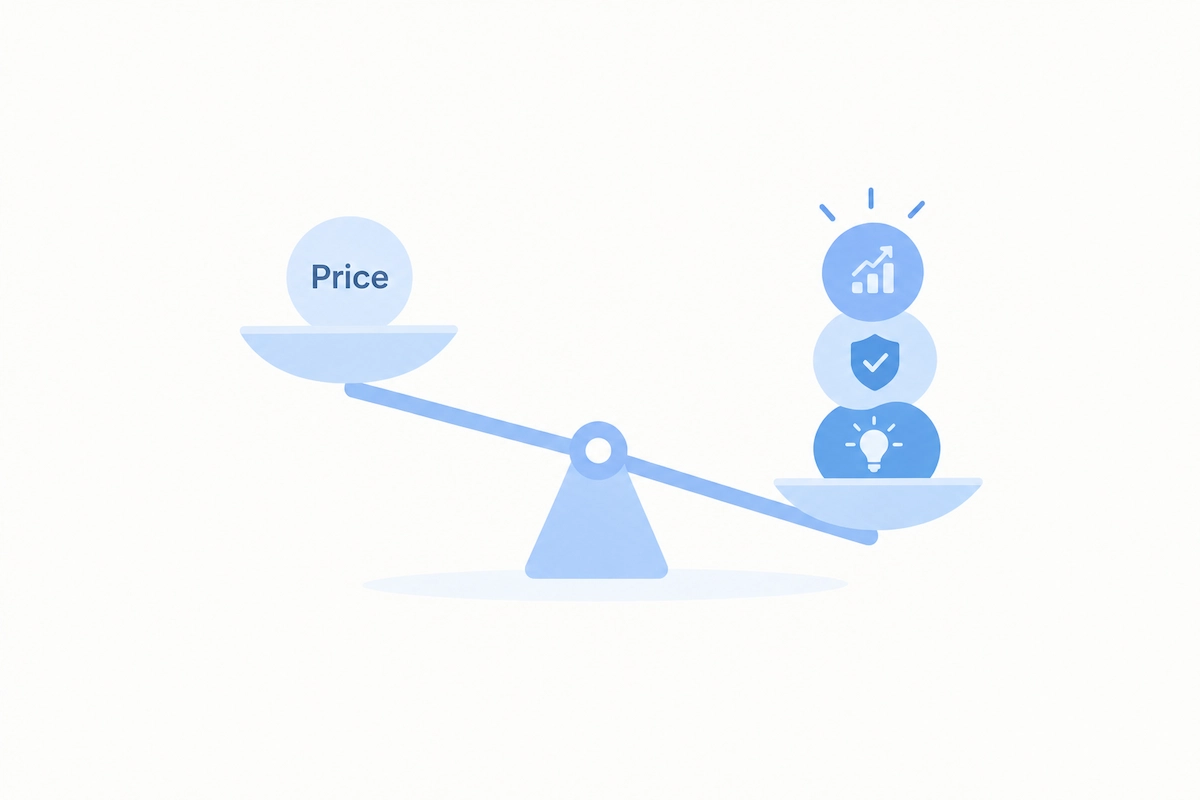
Now flip it. When someone says your fee is too high, what they are really saying is "I could not see enough evidence that you are worth this much." That evidence lives in your website, your proposal, your positioning, and the way you talk about what you do. If those things look like a $3,000 provider and you quote $12,000, the brain does a quick sum and lands on "too expensive."
What is really going on is a gap between how good you actually are and how good you look from the outside. The bigger that gap, the more price resistance you will feel, no matter how fair your rates are.
The maths the client does in their head
Price is never judged on its own. It is judged against perceived value. If perceived value is low, any number feels high. If perceived value is high, a big number feels like a smart decision. Your job before the proposal even lands is to raise the perceived value, not lower the price.
What to say in the moment
Let's deal with the conversation first, because you have probably got one of these sitting in your inbox right now.
Do not apologise and do not discount
The instinct is to soften. "Oh totally understand, let me see what I can do." Please do not. The moment you discount without changing the scope, you confirm that the original price was padding. And the client learns that pushing back works, which they will do again at every invoice.
Get curious instead
A response that works, in plain words: "Totally fair to flag that. Can I ask what you were expecting to invest, and what you were comparing it to?"
This does two things. It tells you whether they have a real budget constraint or just a perception problem. And it gets them talking about the alternatives, which is usually where you find out they are comparing you to something that does not do what you do.
Reconnect price to outcome
Once you know what they were expecting, bring it back to the result. Something like: "The reason it sits at this level is because this isn't just delivering X, it's fixing Y, which is the thing costing you Z right now." Concrete, specific, no fluff. If you cannot say that sentence about your own offer, that is a positioning problem, and I will get to it.
Offer a smaller scope, never a smaller price
If budget is real, reduce what they get. "If the full engagement isn't right for now, we can start with the first phase and build from there." Same rate, less work. Your value stays intact and they still get a way in.
Be willing to let it go
Some people are not your client. That is fine. A gracious "No worries at all, sounds like we're not the right fit for this one, I hope it goes well" is far better for your brand than a discounted project with a client who already thinks you are overcharging.
Not sure what your website is actually costing you?
Four Questions. Two minutes
Why you keep hearing it (the bit that actually fixes it)
Handling the objection well is good. Not getting it in the first place is better. Price resistance is a symptom. Here are the usual causes I see when I run a brand & web audit for an established service business.
Your website was built for the business you had five years ago
You have grown. Your rates have grown. Your website has not. It still says the things you said when you were hungry for any client at all. People land on it, form a view of your level, and that view is out of date. Then the proposal arrives and there is a mismatch. I wrote about this in when your website no longer matches how good you've become.
You explain what you do, not what changes
"We provide strategic consulting services to businesses." Great. So does everyone. Clients do not pay premium rates for a category. They pay for a specific outcome they cannot get elsewhere. If your copy stops at the deliverable, the client has nothing to weigh your price against except other people's prices.
There is no proof between the first look and the proposal
Case studies, results, named clients, before and after. If the client cannot find evidence that you have done this before and it worked, they have to take your word for it. And your word, however good, does not justify a premium. Have a look at how I frame outcomes on my case studies page. Every one leads with the result, not the deliverable.
Your proposal arrives cold
If the first time a client sees a real number is in a PDF, you have lost control of the framing. Talk about investment ranges on the call. Put a starting price on your website. Let people self-select before you spend two hours on a proposal.
How do you respond when a client says you are too expensive?
Stay calm and do not discount. Ask what they were expecting to invest and what they are comparing you to. Reconnect your price to the specific outcome you deliver. If budget is the real issue, offer a smaller scope at the same rate rather than a lower price. If it is still not a fit, let it go gracefully.
What changes when the gap closes

When Beneath the Palms Midwifery came to me, they had a site that looked fine but had no strategy behind it. It did not reflect how experienced they were or why someone should choose them. After the rebuild, they were booked out for the rest of the year and added two new services. Nobody was asking them to justify their pricing anymore. The website was doing that before the conversation started.
That is the goal. Not winning the objection. Removing it.
When your positioning is clear, your proof is visible, and your website looks like the level you operate at, the price conversation changes. Instead of "that's more than we expected," you hear "that makes sense, when can we start?"
Stop defending your price and start earning it before the call
If you are hearing "too expensive" more than once or twice a quarter, it is not a pricing problem. It is a perception problem, and it lives in what people see before they ever talk to you.
The quick fix is a better response script, and you now have one. The real fix is closing the gap between how good you are and how good you look. That starts with knowing exactly where the gap is.
Should I lower my prices if clients keep saying I am too expensive?
No. If you are established and your results are strong, repeated price objections usually mean your positioning and website are not showing your value. Lowering prices confirms the doubt and attracts more price-sensitive clients. Fix what people see before the proposal, then hold your rates with confidence.
Should I put my prices on my website?
For most service businesses, yes, at least a starting point or a range. Showing an investment level lets the right people self-qualify and filters out clients who were never going to pay your rate. It also means your proposal is never the first time someone sees a number.
How do I explain my price without sounding defensive?
Tie the price to a specific outcome, not a list of tasks. Say what problem it fixes and what that problem is currently costing them. Speak plainly and stop there. Defensiveness comes from over-explaining. Confidence comes from having a clear answer and being comfortable if they say no.